How i See in Black and White!
How do I know if an image is suitable to converted into Black and White. Its easy!
First, I look to see if there is a general hue or tone to the image. Does the scene have a blue cast,such as on a cold day. Is there fog present in the image. Are the colors muted or do the colors look washed out? Or are there warm colors(yellows,reds or oranges)? Is everything green? These are all indications that the photograph might work well in black and white.
I also will squint my eyes to decrease the colors reaching my eyes. This will help create a colorless scene.
I will also look to see if the image is very busy. Are there green leaves everywhere? Are there any colors that jump out at me? Is there a lot of contrast in the image?
<a href="http://fineartamerica.com/art/all/scenery/posters" style="font: 10pt arial; text-decoration: underline;">scenery posters</a>
When traveling, remember to go with the flow!
I just got back from a recent trip to Banff National Park. I knew when I booked the trip that it June was their "rainy" season. Well, not only did it rain, but it rained more in 2 days while I was there than it had in 6 months.
They got so much rain, that my scheduled photography outings got washed out. Thats right, the road washed out leading into banff, trapping vacationers for days. I was one of them!. Not only were the roads washed out, but do to flooding, half of my trip washed out too. The first group of locations turned to mud. And, then became so flooded that the parks department sectioned off those areas preventing traveling.
So, I waited. I was prepared to extend my trip. However, 4 days later things improved drastically. The roads north of me in Lake Louis were opened and so did the cloudy blue skies.
Although, I was slightly stressed when this drama started to unfold, I soon realized that all was not lost. Not completely. And, by the end of the 12 day trip, I had some great photographs!
<a href="http://fineartamerica.com/art/all/scenery/metal+prints" style="font: 10pt arial; text-decoration: underline;">scenery metal prints</a>
My first publication in a magazine!
This is my first photograph published in Black and White Magazine. I was pleasantly surprised that Black and White Magazine chose this as one of the finalist in their Single Image Portfolio Contest. Its not my favorite image, but it is certainly interesting!


<a href="http://fineartamerica.com/art/all/scenery/acrylic+prints" style="font: 10pt arial; text-decoration: underline;">scenery acrylic prints</a>
Your vision of photography might not be mine!
I had a discussion with a fellow photographer the other day and the topic of "why I bracket my photo's" came up.
Bracketing involves taking multiple exposures of the same scene. I do this because, in my opinion, the camera is limited in its dynamic range. It cannot properly read a scene that has a bright sky, while there is a dark foreground. The camera's dynamic range is limited. You can get close, but when I photograph a grand landscape, there is a considerable difference between the light from the ground and the light from the sky.
So, when I take photographs, I take extra pictures knowing that I will be combining them in photoshop to produce the optimum image.
Yes, I could use a single exposure and brighten the dark areas and decrease the bright areas, but this produces one major issue. NOISE!. When you try to adjust for the dark and light areas, the images starts to get grainy and appears to be dirty.
<a href="http://fineartamerica.com/art/all/scenery/framed+prints" style="font: 10pt arial; text-decoration: underline;">scenery framed prints</a>
My interpretation of an iconic scene-a nice Surprise!
I recently took a trip to up to Canada to visit Banff National Park. I wanted to photograph one particular region of the park. 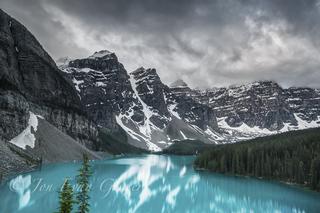
I was browsing on photographs on Ebay about a year and a half ago and came across a photograph of some mountains covered in snow while the lake in the foreground appeared to be turquoise in color. I was quickly drawn to this color and began to search the internet to find out where this amazing location was. I had to find it!! After about 20 minutes of research, I had discovered the location, Lake Moraine in Banff National Park.
I looked over hundreds of photographs of the lake, mapped it out on Google Earth, and thus began my goal to visit the region. It took me about 14 months of waiting before I could go, but it was worth it.It was spectacular!
The color of the water was turquoise/ blue.. The water that comes that comes off the glaciers is an amazing hue of blue.
Anyways, I had a preconceived idea of what the lake looked like and where I was going to take some photographs. I figured that it would be pretty much the same thing as thousands of others had taken. The classic shot of Lake Moraine( the same one that is on their currency).
To my surprise the photograph is similar, but a completely different interpretation of the scene.
And yes, I am quite pleased with it!!
<a href="http://fineartamerica.com/art/all/scenery/prints" style="font: 10pt arial; text-decoration: underline;">scenery prints</a>